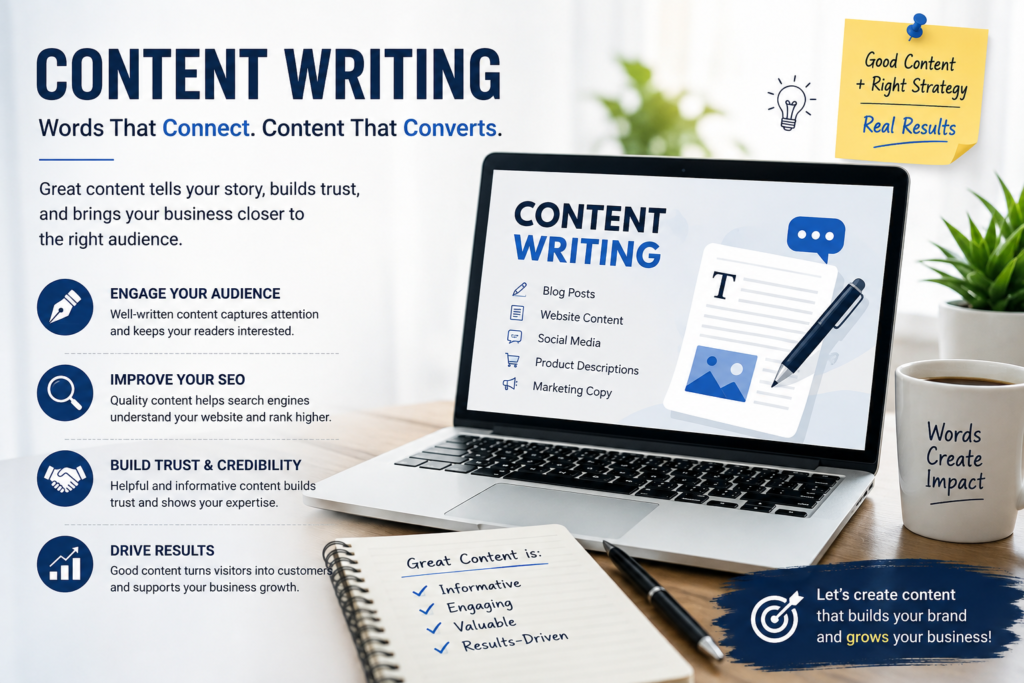

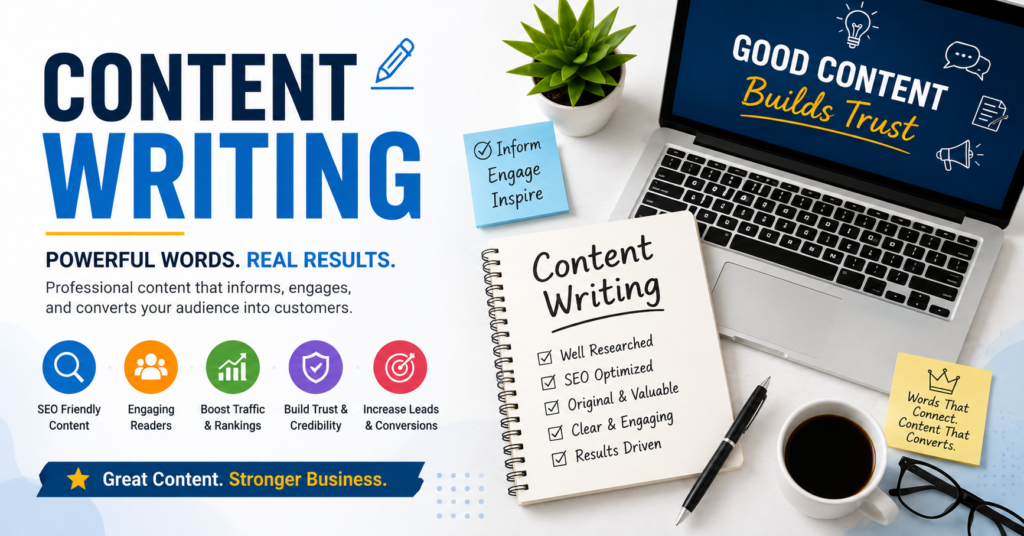
In today’s competitive digital world, businesses need more than a website to attract customers. They need clear, useful, and engaging information that helps people understand their products and services. Content Writing plays an important role in building that connection. From website pages and blog articles to social media posts and product descriptions, effective content can help a business communicate its message and reach the right audience.
Professional content can also support search engine optimization, improve brand credibility, answer customer questions, and encourage visitors to take action. When planned correctly, it becomes an important part of a complete digital marketing strategy.
1. What Is Content Writing?
Content Writing is the process of creating written material for a specific audience and purpose. The goal is not simply to put words on a webpage. Good content should provide useful information, communicate a clear message, and help readers take the next step.
Businesses use different types of content depending on their goals, audience, and industry for Content Writing.
Common examples include:
- Website content
- Blog posts and articles
- Service pages
- Product descriptions
- Social media posts
- Landing page copy
- Email marketing content
- How-to guides
- Case studies
- FAQs
- Advertising copy
Good writing should be clear, original, relevant, and easy to understand. It should also match the tone of the brand and provide genuine value to readers.
2. Why Content Writing Is Important for Your Business
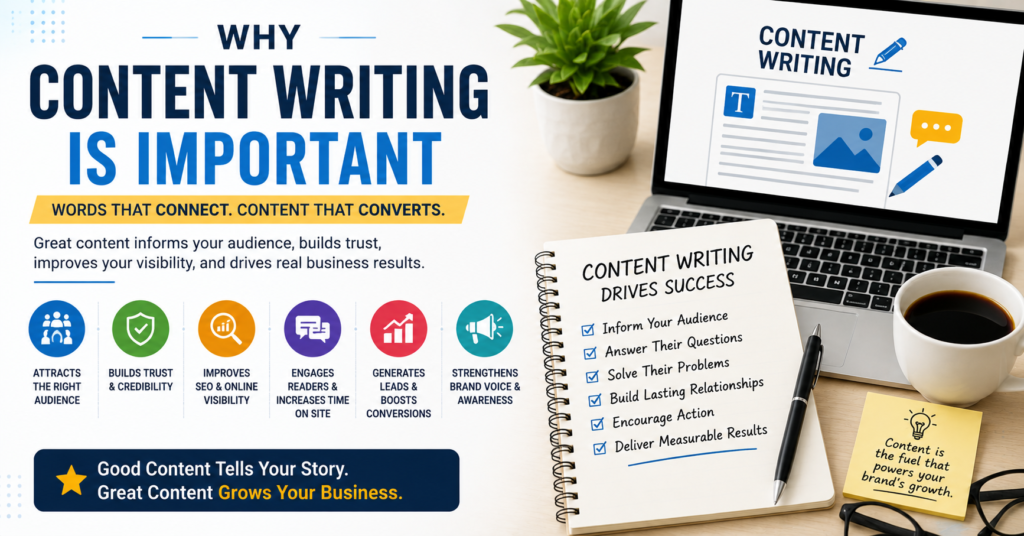
Your website is often one of the first places potential customers learn about your business. If visitors cannot quickly understand what you offer, they may leave and look somewhere else.
Strong Content Writing helps explain your business in a simple and persuasive way. It can introduce your services, answer questions, explain benefits, and show customers why your business is worth considering.
Content Writing can help businesses:
- Communicate their message clearly
- Build a professional online presence
- Educate potential customers
- Increase website engagement
- Support SEO efforts
- Generate leads
- Build brand trust
- Encourage conversions
The best content content writing focuses on the customer first. Instead of talking only about the business, it should explain how the business can solve a customer’s problem.
3. Content Writing and SEO
Content Writing and SEO work closely together. Search engines need to understand what a webpage is about, while users need useful information that answers their questions.
A well-planned content strategy can help your website target relevant search queries and create useful resources for your audience.
Important areas include for Content Writing:
- Keyword Research — Find relevant search terms your target audience uses on Google.
- Search Intent — Understand what users want when they search for a particular keyword.
- Helpful & Original Information — Create unique, useful content that answers users’ questions and provides real value.
- Proper Headings — Use H1, H2, and H3 headings to organize content and make it easy to read.
- Internal Linking — Link relevant pages on your website to help users navigate and help search engines discover your content.
- Optimized Images — Compress images, use suitable file formats, and add descriptive alt text for better performance and accessibility.
- Descriptive URLs — Create short, clear URLs that tell users and search engines what the page is about.
- Clear Page Structure — Organize content logically with headings, short paragraphs, lists, and easy navigation.
However, SEO content should never be written only for search engines. Repeating the same keyword excessively can make an article difficult to read.
Instead, use your main keyword naturally and include related terms where they genuinely make sense.
4. How Keyword Research Improves Content Writing
Before creating an article or website page, it is useful to understand what your audience is searching for.
Keyword research helps identify topics and phrases that are relevant to your products, services, and customers.
A good keyword strategy considers:
- Search Intent — Understand what users are looking for when they search a particular keyword.
- Keyword Relevance — Choose keywords that closely match your business, products, or services.
- Search Demand — Check how often people search for a specific keyword or topic.
- Competition — Analyze how difficult it may be to rank for a particular keyword.
- Long-Tail Keywords — Use specific, longer search phrases that often have clearer intent and lower competition.
- Customer Needs — Identify the problems, questions, and solutions your target customers are looking for.
- Business Objectives — Select keywords that support goals such as increasing traffic, generating leads, getting sales, or building brand awareness.
For example, someone searching for “what is SEO?” probably wants educational information, while someone searching for “SEO agency near me” may already be looking for a service.
Understanding this difference allows you to create content that matches the user’s purpose.
5. Create Content for Different Stages of the Customer Journey
Not every visitor is ready to buy immediately. Some people are researching a problem, while others are comparing solutions.
Content can support customers at different stages.
Awareness Stage
At this stage, people are looking for information.
Useful content includes:
- Blog Posts — Share useful information, tips, and insights while targeting relevant search keywords.
- Educational Guides — Provide detailed information that helps readers understand a topic or solve a problem.
- Industry Articles — Discuss industry trends, news, and expert insights to build authority and credibility.
- Beginner Tutorials — Explain topics step by step in simple language for people who are new to the subject.
- Informational FAQs — Answer common questions quickly and clearly to help users find the information they need.
Consideration Stage
Visitors are now researching possible solutions.
Useful content includes:
- Service Pages — Explain your services, benefits, process, and how your business can solve customer problems.
- Comparisons — Compare products, services, or solutions to help customers make better decisions.
- Case Studies — Show real examples of your work, results, and how you helped customers.
- Detailed Guides — Provide in-depth information and practical advice about a specific topic.
- Product Information — Explain product features, benefits, specifications, and important details to help customers choose.
Decision Stage
The customer is closer to taking action.
Useful content includes:
- Landing Pages — Designed to focus visitors on one specific goal, such as signing up, requesting a quote, or making a purchase.
- Testimonials — Share genuine customer experiences to build trust and confidence in your business.
- Offers — Highlight discounts, promotions, or special deals to encourage customers to take action.
- Product Pages — Explain product features, benefits, pricing, and other details to support buying decisions.
- Contact & Inquiry Pages — Make it easy for visitors to contact your business, request information, or submit an inquiry.
Creating content for each stage can help move visitors naturally from information to action.
6. Website Content That Converts Visitors
Your website content should have a clear purpose. Every important page should help visitors understand what you offer and what they should do next.
For example, a service page can explain:
- What the service is
- Who it is for
- What problems it solves
- What benefits customers receive
- How the process works
- Why customers should choose your business
- How to get started
Strong calls to action can also make the next step clear.
Examples include:
- Get a Free Consultation
- Contact Us Today
- Request a Quote
- Learn More
- Get Started
- Talk to Our Team
Clear writing combined with a useful call to action can make your website easier to navigate and more effective.
7. Blog Content That Attracts Visitors
Business blogs can be a valuable way to answer customer questions and target informational searches.
Instead of publishing random articles, create content around topics your audience actually cares about.
A strong blog strategy can include:
- Industry tips
- How-to articles
- Frequently asked questions
- Beginner guides
- Product education
- Industry trends
- Common customer problems
- Expert insights
Before publishing an article, ask whether it provides something useful to the reader.
A good blog post should have a clear topic, logical structure, readable paragraphs, useful headings, and practical information.
Updating older articles can also be valuable when information becomes outdated or new insights become available.
8. Content Writing for Social Media
Social media gives businesses another opportunity to communicate with their audience.
Social media Content Writing is usually shorter and more engaging than long-form website content. The goal is to capture attention quickly and encourage interaction.
Effective social media content can include:
- Educational tips
- Short industry insights
- Customer questions
- Product highlights
- Promotional messages
- Behind-the-scenes content
- Success stories
- Short videos with captions
Each platform may require a different style. A professional LinkedIn post may be more informative, while an Instagram caption may be shorter, visual, and conversational.
The important thing is to keep your brand voice consistent while adapting the message to the platform.
9. Product and Service Descriptions
Product and service descriptions help customers understand what you offer and why it matters.
A weak description may simply list features. A stronger description explains the benefit of those features.
For example, instead of only saying that a service includes “SEO reporting,” explain how reporting helps the customer understand traffic, rankings, leads, and campaign progress.
Effective descriptions should:
- Explain the main benefits
- Answer customer questions
- Use simple language
- Highlight important features
- Include relevant keywords naturally
- Address customer concerns
- Include a clear call to action
Good descriptions can make the buying decision easier because customers have the information they need.
10. Build Trust Through Valuable Content
People are more likely to engage with businesses they trust. Content can help demonstrate knowledge, experience, and understanding of customer problems.
Businesses can build credibility by publishing:
- Helpful guides
- Case studies
- Customer success stories
- Industry insights
- Original research
- Expert advice
- Detailed FAQs
- Useful resources
Avoid making claims that cannot be supported. Be clear about what your business actually provides and use evidence where appropriate.
Trust is built over time through consistent communication and valuable experiences.
11. Content Writing and User Experience
Good content is not only about what you say. It is also about how easily people can read and understand it.
Large blocks of text can make a page difficult to scan. Breaking information into sections makes it easier for visitors to find what they need.
Use:
- Short paragraphs
- Descriptive headings
- Bullet points
- Numbered sections
- Clear sentences
- Relevant images
- Helpful links
- Strong calls to action
Your writing should also work well on mobile devices because many visitors access websites through smartphones.
12. Internal Linking for Better Website Navigation
Internal links connect one page of your website to another. They help visitors discover related information and can also help search engines understand the structure of your website.
For example, a Content Writing article can naturally link to your:
- SEO Services page
- Digital Marketing Services page
- Google Ads page
- Social Media Marketing page
- YouTube Ads page
Use descriptive anchor text so readers understand what they will find after clicking.
Avoid adding links randomly. Every internal link should be relevant and useful.
13. Using External Resources
External resources can strengthen an article when they provide additional trustworthy information.
For example, you can link to respected sources for information about:
- Search engine guidelines
- Digital marketing research
- Industry statistics
- Content best practices
- Website accessibility
- Marketing trends
When adding external links, choose websites that are authoritative and genuinely relevant to the topic.
The purpose of an external link should be to help the reader, not simply to increase the number of links on a page.
14. How to Create High-Quality Content
Creating useful content starts with research. Before writing, understand your audience, competitors, topic, and search intent.
A simple process is:
Step 1: Understand Your Audience
Identify who you are writing for and what problems they are trying to solve.
Step 2: Research the Topic
Review reliable information and identify important questions people may have.
Step 3: Choose Your Keywords
Select a primary keyword and related phrases that match the topic.
Step 4: Create an Outline
Organize the article using logical H2 and H3 headings.
Step 5: Write Naturally
Explain the subject clearly without unnecessary jargon or keyword stuffing.
Step 6: Add Useful Examples
Examples make complicated ideas easier to understand.
Step 7: Optimize the Page
Review titles, headings, links, images, URLs, and metadata.
Step 8: Edit and Proofread
Remove unnecessary sentences, fix grammar issues, and make the article easier to read.
15. Common Content Mistakes to Avoid
Even businesses that publish regularly can make mistakes that reduce the effectiveness of their content.
Avoid:
- Writing only for search engines
- Keyword stuffing
- Copying content from other websites
- Publishing without researching the audience
- Using misleading headlines
- Creating extremely long paragraphs
- Ignoring spelling and grammar
- Forgetting calls to action
- Publishing outdated information
- Focusing only on quantity instead of quality
The goal should always be to create content that provides genuine value.
16. Measure Your Content Performance
Publishing content is only part of the process. You should also monitor how your content performs.
Useful metrics include:
- Organic traffic
- Page views
- Engagement
- Search rankings
- Click-through rate
- Leads
- Conversions
- Time spent on pages
- Returning visitors
These measurements can show which topics attract attention and which pages need improvement.
If an article receives traffic but produces few conversions, you may need to improve the call to action or make the page more relevant to the visitor’s needs.
17. Why Businesses Should Invest in Professional Content Writing
Creating quality content consistently requires time, research, writing ability, SEO knowledge, and editing.
A professional Content Writing service can help businesses maintain a consistent publishing schedule while keeping their message clear and professional.
Professional writers can help with:
- Content research
- SEO-focused articles
- Website pages
- Service descriptions
- Blog strategies
- Social media copy
- Editing and proofreading
- Content updates
This allows business owners to focus on running their business while their online content continues to support marketing goals.
18. Content Writing and Long-Term Business Growth
Content can continue delivering value after it has been published. A useful article may attract visitors through search engines for months or even years when it remains relevant and is properly maintained.
A long-term Content Writing strategy can help businesses:
- Attract new audiences
- Answer customer questions
- Build topical authority
- Support SEO
- Increase website visibility
- Generate leads
- Strengthen brand awareness
However, results depend on many factors, including competition, website quality, search demand, content quality, and consistency.
Content should therefore be viewed as part of a broader digital marketing strategy rather than a quick solution.
19. Content Writing Checklist
Before publishing a new article or webpage, review the following:
- Is the topic relevant to your target audience?
- Does the content answer the reader’s question?
- Is the primary keyword used naturally?
- Does the title clearly describe the topic?
- Are the headings properly structured?
- Is the content easy to scan?
- Are relevant internal links included?
- Are useful external resources included?
- Are images optimized with descriptive alt text?
- Is there a clear call to action?
- Has the content been proofread?
- Does the page work well on mobile devices?
20. Final Thoughts
Content Writing is much more than putting words on a website. It is a way to communicate with customers, answer their questions, demonstrate expertise, and guide them toward useful actions.
When combined with SEO, content strategy, social media, paid advertising, and a strong website experience, quality content can become an important part of your digital marketing efforts.
The best approach is to focus on your audience first. Understand what they need, create useful information, organize it clearly, and make it easy for them to take the next step.
Consistent, helpful, and well-optimized content can strengthen your online presence and create valuable opportunities for your business over time.
Great Content Writing informs. Great content builds trust. And great Content Writing can help turn interested visitors into loyal customers.